Editor’s note: Since 1983, the Inner City Ministry of Cru® has been serving vulnerable and marginalized residents in some of the nation’s largest cities. What motivates these teams of missionaries and church partners to provide resources and spiritual guidance in these struggling neighborhoods? We tackle that question in our three-part series “Being Seen.” Last week, we examined the motivation behind inner-city ministry. Today, in Part 2, we explore the Scriptures that inspire some of our team members. Next week, we conclude the series with a look at several more Scriptures and their meaning to our team.
Tina emerged from prison a dozen years older, having completed her sentence for auto theft and numerous drug charges. She was finally free from the Orlando-area facility, but with few options.
Despite closing in on retirement age, Tina’s limited work experience and criminal record weren’t exactly resume boosters.
In many ways, life was more difficult post-incarceration because at least inside she was seen — seen by cameras, guards and fellow inmates.
But outside, without the support of people or programs, she slipped through the cracks, spending two years camped underneath a utility truck, its metal undercarriage her makeshift roof.
When she was finally seen, it was by Timothy McKinney, the CEO of Transformation Village, an ongoing ministry project of United Global Outreach, which also operates the not-for-profit academy for at-risk children. He arranged for Tina to get help with her addiction and offered her a job to help her get back on her feet. Along the way, she found Jesus.
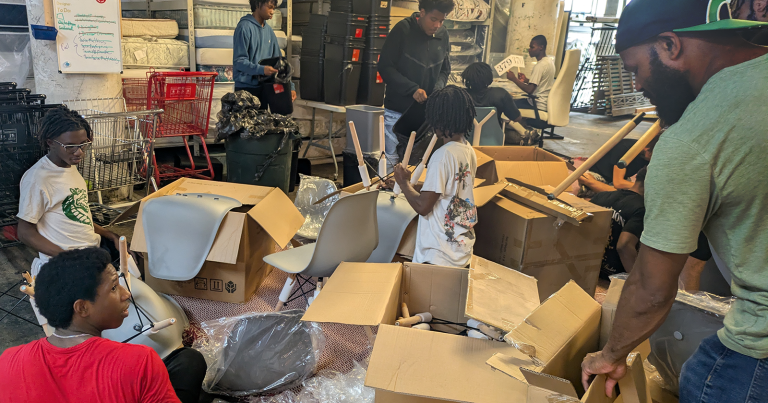
Six months into her sobriety, Tina met Camryn, an Ohio college student who spent her spring break volunteering with Urban Immersion™, a joint venture between the Inner City Ministry of Cru and its partner ministry, Transformation Village. The two unlikely companions, vastly different in their ages and social status, became fast friends, as Tina soaked up the unconditional love Camryn showered on her.
“She had sad stories,” Camryn said. “I am a true believer that even when you’re old, and you’ve been through stuff, you can break the domino effect that your family carries.”
Not only has Tina overcome addiction, but she has also landed a full-time welding job, earned her driver’s license and has an apartment she shares with a roommate.
“She made a decision to follow Him, but it took her a while,” Camryn said. “Tim had to convince her that God was real. She finally caught on to that and said that’s the only reason she’s still alive.”
Seeing others is at the core of what drives the Inner City Ministry of Cru. It’s about celebrating and respecting the imago Dei — the image of God — in all humans. For staff members of Inner City, that mission starts and ends with Scripture, which covers a lot of ground about caring for the poor and marginalized, including widows, children, prisoners, and strangers.
So, what does Scripture say? We asked six Inner City staff members to share their favorite Scriptures on poverty and how it shapes their work. What emerged was a series of See Statements on how they effectively serve others in the inner city.
See With Intention
Michelle Bohemier, who serves as executive assistant to Milton Massie, Inner City’s executive director and steward of the Inner City, said her favorite Scripture addressing the needs of the urban community is Proverbs 31:8–9:
“Open your mouth for the mute, for the rights of all who are destitute. Open your mouth, judge righteously, defend the rights of the poor and needy” (English Standard Version).
“I love this passage because it reminds me that God sees those who are often overlooked and invites us to see them, too,” she said. “Poverty is not only about a lack of resources, but about people who are unheard, unseen, and easily forgotten. This Scripture helps me remember that loving our neighbors includes paying attention and being willing to step toward others with compassion.”
‘Poverty is not only about a lack of resources, but about people who are unheard, unseen, and easily forgotten.’
Being seen, she said, should spur believers to action.
“What feels especially meaningful to me is that the call is both tender and active,” Bohemier said. “God does not simply stir our hearts with concern; He invites us to use our voices, our presence, and our influence to reflect His care. For me, this passage is a gentle but steady reminder that following Jesus means walking closely with those on the margins and trusting Him to shape our hearts as we do.”
See With Humanity
Marc Henkel, who co-directs the Chicago team and has served in the Windy City for 36 years, said that with more than 2,000 verses focusing on four people groups — the poor, the orphan, the widow and the stranger — it is difficult to single out just one.
“There are many to choose from,” he said. “This shows that caring for the poor, or the ‘least of these,’ is very central to God’s heart.”
Among his favorites is Matthew 25:31-46, in which Jesus discusses the final judgment where God, using the allegory of separating sheep and goats, divides people into two camps: those who served others and those who did not. This passage reveals the importance God places on caring for those in need.
“Only those who put their trust in Christ will be saved, but anyone who is truly saved will desire to care for the least of these,” Henkel said. “Anyone can say they are a Christ follower, but how they treat the least of these shows what is really in a person’s heart.”
‘Anyone can say they are a Christ follower, but how they treat the least of these shows what is really in a person’s heart.’
Further, Henkel said the passage underscores both the humanity and divinity of Christ, emphasizing how every person is made in the image of their Creator.
“I love how Christ identifies Himself with the least of these,” he said. “Whatever we have done or not done to them is how we treat Jesus …. super intriguing and super challenging.”
In the broader context of Matthew 25, Henkel points out that the chapter presents three distinct parables, which he believes indicate the different questions on the “final exam.”
- The parable of the 10 Virgins — Are our lamps burning for Christ? How much do we love God? At Inner City, Henkel said, demonstration of love for God is practiced through a ministry model that focuses on the whole person.
- The parable of the Talents — Are we using our time, talents, treasure to serve God? Inner City interprets this as a call to make disciples.
- The parable of the Sheep and Goats — Do we love the least of these? Our ministry model interprets this as a call to love people.
See With Compassion
Valerie Seely, who works with the Inner City team in New York, said she is moved by the compassion she sees in Jesus and acknowledges that it’s difficult to select a specific verse when the topic is so widely covered in the Bible.
“The verses I think about most, however, are Jesus’ feelings and actions when He saw people around Him struggling,” she said, citing Matthew 9:36, 14:14 and 15:32.
“He looked at people in spiritual, emotional, and physical need and had compassion. I never want to mistake pity for compassion. Compassion is identifying and feeling with someone, while pity feels sorry for someone. Jesus saw the value of people as image bearers. He saw their story and painful situations. He came alongside them and offered them hope, not judgment.”
‘I never want to mistake pity for compassion. Compassion is identifying and feeling with someone, while pity feels sorry for someone.’
She warned that pity can elevate one over another, which can either hamper their ability to see “their holy humanity” or cause them “to be a judge over their story.”
“Jesus’ compassion compelled Him to move toward, touch, feed, heal, rescue, comfort, the beautiful embodied souls around Him,” she said. “I want that to be true of me.”
Join us next week as we conclude our “Being Seen” series by hearing from three more missionaries to the Inner City.