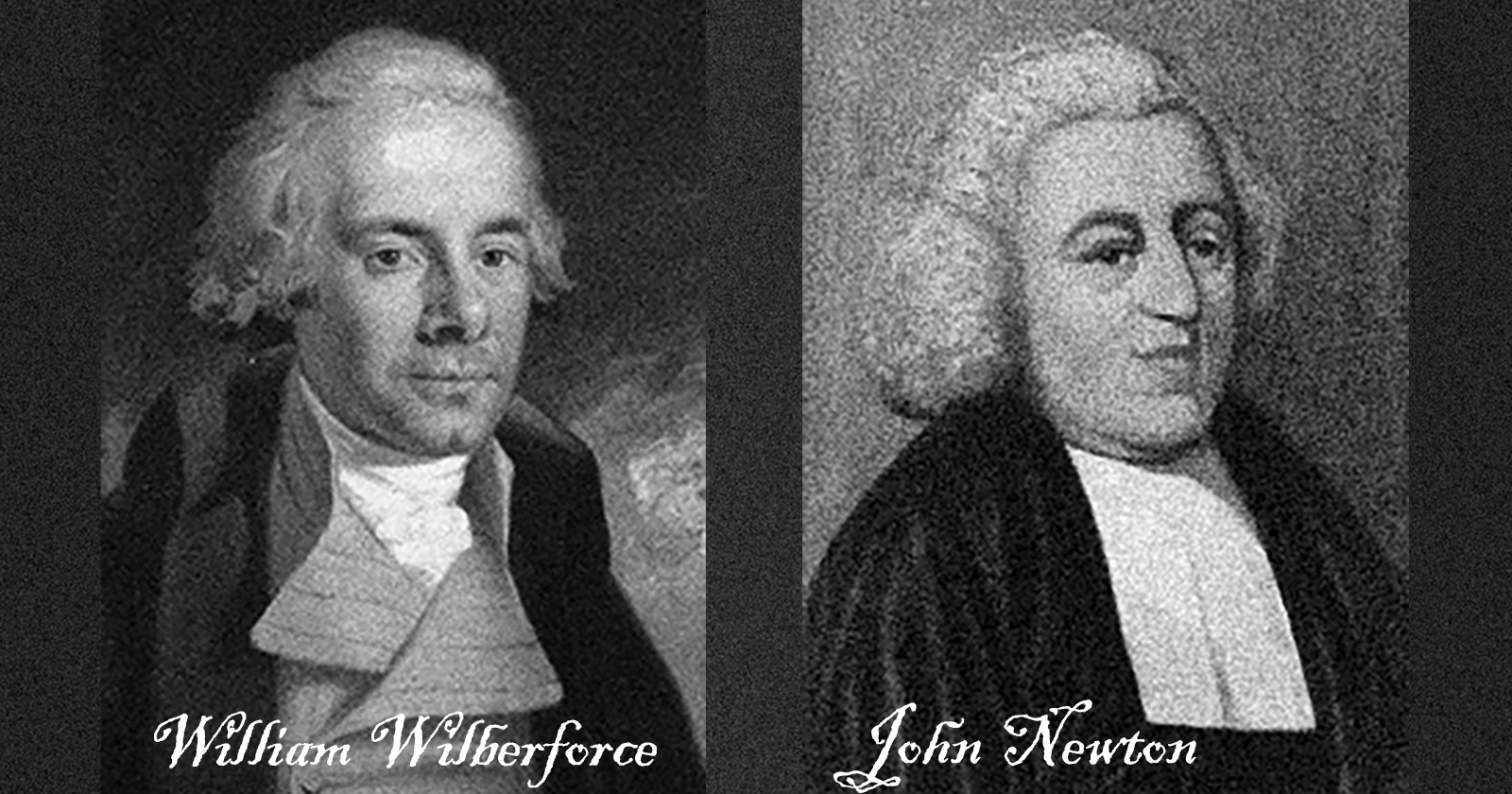
William Wilberforce lay sick in bed, a serious illness keeping him from his duties as a member of England’s Parliament. Just a year earlier, Wilberforce, a newly converted Christian, entered a long period of prayer and self-questioning, and vowed to fight the slave trade on the national stage. He was following the lead of his mentor, John Newton, a former slave trader turned pastor.
Wilberforce realized, if he recovered, what hardships certainly awaited him if he tried to follow through on his commitment. The lawmaker would be taking on one of Britain’s most profitable industries. Newton depended on Wilberforce to bring about his dream of abolition and was devastated about the worsening prospects of the movement.
While Wilberforce was out of commission, Newton mentally rehearsed every painful memory from onboard a slave ship. He relived every cruel action he inflicted upon Africans, which he had come to see as image-bearers of God. He revisited the inhumane conditions. He recalled the brown eyes of every soul he turned away from, leaving them in chains to rot and die. Every sinful deed prompted a plea for God’s forgiveness from the man who penned the words, “Amazing grace, how sweet the sound that saved a wretch like me.” He captured every horrific condition and circumstance he could remember and published them in the pamphlet “Thoughts Upon the African Slave Trade.”
He relived every cruel action he inflicted upon Africans he had come to see as image-bearers of God.
“It will always be a subject of humiliating reflection to me,” he wrote, “that I was once an active instrument in a business at which my heart now shudders.” He continued, “It is hoped, this stain of our national character will soon be wiped out.”
In the meantime, Wilberforce, though plagued by illness throughout his life, recovered enough by the next year to advance a bill in Parliament to abolish the slave trade. It failed. He did it again the next year. It failed again. Each year, every attempt to immediately end the slave trade was defeated. In 1796, after seven years of bargaining, cajoling and persuading, Wilberforce finally got enough commitments to pass the bill in the House of Commons.
When it came to the floor for a final vote, some of those supporters chose instead to attend an opera rather than stay to pass the bill. The measure was defeated by four votes. Throughout the end of the 18th century, support for the movement shrank year after year.
Can you relate to the disappointment? Maybe you feel this way about your faith and ministry. Maybe people used to listen to you, but now their focus is on what they find on their phones. Sometimes you feel ostracized or belittled. You are not the first to feel that way.
The writer of the book of Hebrews found himself in a similar situation. The author, like Newton, found himself trying to encourage some disheartened people. We know from chapter 10 of the letter that the recipients were men and women who experienced so much persecution for their faith in Jesus that they became discouraged and were ready to quit. Two chapters later, in Hebrews 12:1-13, we are given a blueprint on how to persevere.
Here are four takeaways:
- Set aside anything slowing you down, v. 1. Is this thing in my life feeding or stunting my growth in faith? If it is slowing you down, get rid of it!
- Get rid of sin. v. 1 What does Paul relate sin to in Romans 6:16? Death and slavery!
- Look to Jesus, v. 2, our example and our treasure.
- See hardship as an opportunity for growth, vv. 5-6.
When we apply such wisdom, what is the result? For Wilberforce, it ultimately led to victory because he never gave up.
In 1807, after more than 20 years of effort, the bill finally passed, thanks to Wilberforce and his allies. As for John Newton, 53 years after leaving the industry and just months prior to his death, he witnessed the abolition of the slave trade throughout the British Empire.
Despite the achievement, Wilberforce’s work was not finished. He lobbied other governments, including America, to do the same. And, though the slave trade was outlawed in England, slavery itself remained legal. He spent the next 25 years fighting for its outright abolition. In 1833, three days before his death, Wilberforce received news the House of Commons finally passed a law emancipating all slaves throughout the British Empire.
We read history just as God sees our lives — knowing the beginning and the end. But we live life moment by moment. Some moments are better than others. For most of John Newton’s life, he was haunted by the horrible deeds of his past. He did not see fruit from his ministry for countless years. Yet his work has impacted the lives of billions of people and counting!
If you remain steadfast, what could God do with your life and ministry?
If you remain steadfast, what could God do with your life and ministry? What if you are raising the next William Wilberforce? What if you’re discipling the next Martin Luther King Jr.? What if one of the kids who receive an Easter bag becomes the next Corrie Ten Boom? Set aside anything slowing you down, especially sin, look to Jesus, and see hardship as an opportunity.