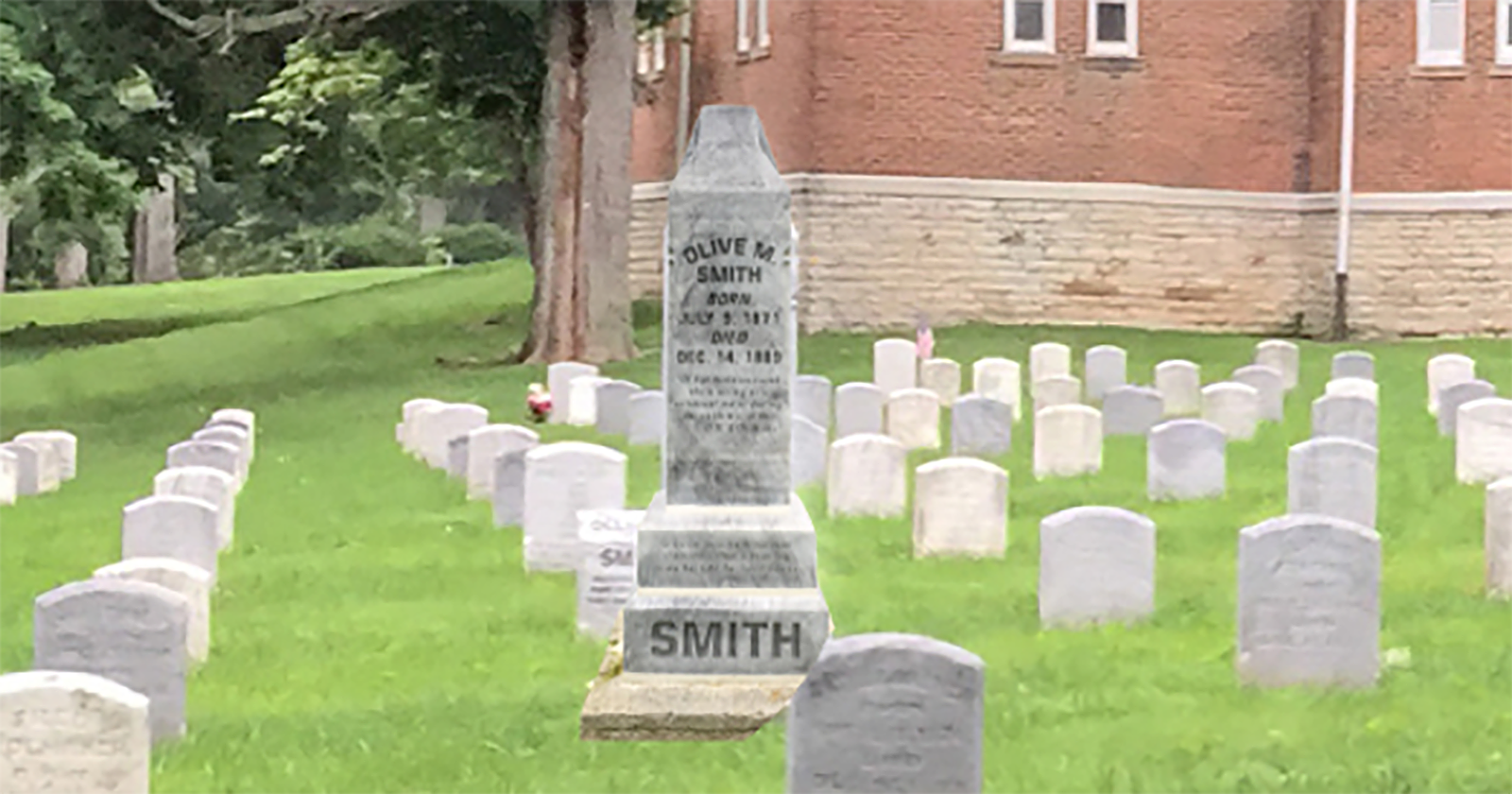
JT was walking the cemetery grounds where tombstones listed the names of dozens and dozens of 19th- and 20th-century children, many younger than the high school freshman. When he and his campmates arrived at the distinctive memorial of 18-year-old Olive Smith, it was her story, not the headstone, that caught their attention.
Olive was just a few years older than the African American teen when she volunteered to nurse the children at the Ohio Soldiers and Sailors Orphan Home, which opened in 1869 to serve youngsters who had lost their veteran fathers during the Civil War.
The home was gripped by loss again as a 1918 diphtheria outbreak spread through the orphanage, killing more than 30 children. Olive diligently cared for her patients until she became one herself. Published reports said her body was discovered clutching two children who also succumbed to the disease. After her death, Olive’s parents buried her alongside those for whom she sacrificed.
More than 130 years after her death, Olive’s story remains an often-cited symbol of love and sacrifice to the campers at the Athletes in Action® Sports Complex in Xenia, Ohio, which currently owns the property of the now-closed orphanage and cemetery. The sports ministry also operates a small on-site museum about the home.
“Part of what we do is explain the importance of this land and what a lady decided to do to sacrifice and serve,” said Jaye Hill, director of the annual JAM Camp for teen boys. “Her life was taken because she decided to stay” with the young patients.
JAM, an acronym for Jesus, Athletics and Manhood, is a multi-dimensional sports camp that offers teen boys skills development through athletic competitions, mental acuity challenges, team-building exercises and leadership development activities, all pointing teens to Christ. While sports are the central focus, the on-site field trip to the historic cemetery underscores the foundational concept of sacrifice for the greater good.
And for JT‚ who enrolled at the camp to improve his basketball skills, Olive’s story proved transformative.
“Why do I complain when these kids died at an early age, but then this lady decided to sacrifice herself?” JT asked Hill.
‘Why do I complain when these kids died at an early age, but then this lady decided to sacrifice herself?’
“He’s realizing even more and more that he needs to be even a bigger servant to Christ, and not always looking for something from his dad or his mom, but the way he can serve them.”
The lessons JT experienced at camp far outpaced his desire to improve on the basketball court. Although he previously participated in travel ball, the weeklong camp was the longest he had been away from home.
“He was a little reluctant,” Hill said.
So was his mother, who requested that JT be allowed to call her midway through the camp. By the second day of camp, JT had already demonstrated integrity when he made the difficult decision to report a fellow camper who was bullying several of the teens and violating other rules.
For the first time in the camp’s 10-plus-year history, they had to send the disruptive camper home early.
“He was just causing too much disturbance, and he just couldn’t get it together,” the director said.
Hill was impressed with JT’s mettle, saying most of the young men who show up for camp can be stymied by peer pressure, but JT was willing to sacrifice his own popularity for the good of the campers.
“You are either trying to fit in or be quiet,” Hill said. “He decided to speak up. He faced his fear.”
Facing fear, whether in sports competition or personal life choices, is an important characteristic that counselors and coaches try to instill.
There were other growing moments for JT, including learning the intricacies of volleyball, which tends to use more finesse than the full-throttle power deployed in hoops. Early on, he struggled with the netted sport.
“He dominates in basketball,” Hill said. “There were moments where JT wanted to give up and didn’t want to keep going. We just had to keep reminding him of who he is and where he comes from.
‘There were moments where JT wanted to give up and didn’t want to keep going. We just had to keep reminding him of who he is and where he comes from.’
“He stretched himself. He was uncomfortable at first. He faced it with confidence, and he overcame it. He became one of our strongest leaders from the (campers’) perspective.”
The change in JT, from the opening session on Sunday to Wednesday’s visit to the cemetery, was striking, Hill added.
“He was looked at as a different person because (of) the way he pushed the other young men … making sure that they were on time for breakfast and lunch and all the things that they were required to do.”
His mom experienced the change, too, while talking during their pre-arranged phone call.
“Mom, I was OK,” the teen told her. “I was missing home the first day and a half. After that, Mom, I was just focusing on learning more about my God.’”
By the end of camp, he pledged he was returning.
“That’s all he talks about,” Hill said. “He’s taken ownership of who God is for his own relationship, and not living his relationship through his dad or his mom or his brother.”
‘He’s taken ownership of who God is for his own relationship, and not living his relationship through his dad or his mom or his brother.’