“Preach the gospel at all times; use words when necessary.”
This quote, widely attributed to St. Francis of Assisi, has — for centuries — been a motivational call for Christian servants. It is a powerful statement urging believers to show, not just tell, because showing the love of Christ is often perceived as a more tangible demonstration than speaking.
It turns out, Assisi is not the author of the quote. In all likelihood, the quote is a paraphrase of the Franciscan Rule (1221), which says, “Let all the brothers, however, preach by their deeds.”
An even bigger issue than the phrase’s origin is this: while motivating, the concept is not biblical. Christians are indeed called to a life of service, to model what Jesus taught and did, to love others. But Jesus never intended for us to demonstrate that love to the exclusion of teaching or preaching His Word.
As I have shared here before, the Great Commission and the Great Commandment are the cornerstone beliefs of the Inner City Ministry of Cru®.
The Great Commandment to love God and love others (Matthew 22:36-40) is a catalyst for being obedient to the mandate to share your faith, which has come to be known as the Great Commission (Matthew 28:19-20).
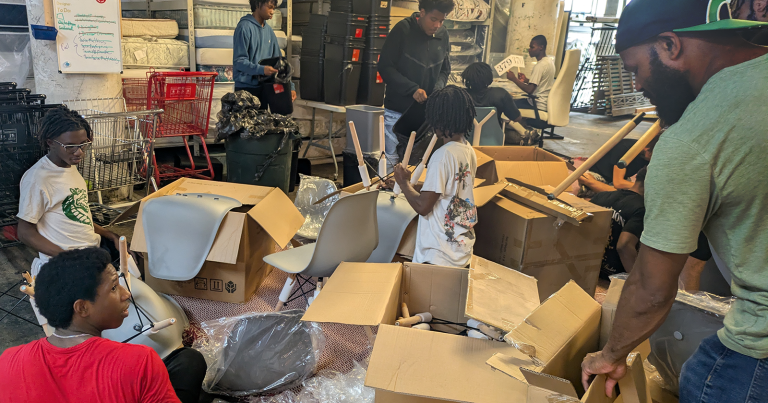
Everything we do through our Inner City outreaches — PowerPack® backpacks, Boxes of Love®, Homeless Care Kits, Easter bags, S.A.Y. Yes!® after-school centers, evangelism and discipleship training, spring and summer missions trips for college students, JAM Camp, prayer walks, biblical resources such as gospel bead bracelets and salvation booklets — all of it is part of our long-established, two-pronged approach: gospel presentation and gospel demonstration.
As believers, we are compelled to share the message of the salvation story and how a person can begin a relationship with Jesus Christ. That is a gospel presentation. But there’s also the way we live, demonstrating how we’ve been transformed because of the gospel. That is the gospel demonstration.
Practically, that means that my involvement, my commitment to love God with all my heart, my soul and my strength, and to love my neighbor as myself, is demonstrated — or lived out — when I share with others the message, the opportunity to come to know the same God who saved my soul.
By using the Compassionate Products™ and the resources I mentioned above, we can meet the real, underlying reason of a person’s initial felt need, such as hunger or homelessness. The practice also reveals to others their real need: to know the bread of life, Jesus Christ.
For our Inner City team and urban partners, this ministry duo of presentation and demonstration has proven to be an effective strategy because it is based on Scripture, including this declaration in Romans:
For our Inner City team and urban partners, this ministry duo of presentation and demonstration has proven to be an effective strategy because it is based on Scripture.
“So faith comes from hearing, and hearing through the word of Christ” (Romans 10:17, English Standard Version).
People can’t hear unless someone is sent, which means those who are sent have to open up their mouths and talk about Christ. The Scriptures make it clear that we’re to follow the example set by Jesus and the early believers. One way we do that is to preach the good news.
The Son of God models this for us in the first chapter of Mark, which chronicles the arrest of John the Baptist, who prepared the way for Jesus’ ministry by baptizing Him in the Jordan River.
“Now after John was arrested, Jesus came into Galilee, proclaiming the gospel of God, and saying, ‘The time is fulfilled, and the kingdom of God is at hand; repent and believe in the gospel’” (Mark 1:14-15, ESV).
Notice that the ESV translation uses the word proclaim. Other translations use the word preach. According to Bible Hub, the word proclaim comes from the Greek word kérussó, which means to “herald like a town crier, especially divine truth,” while the HELPS Word-Studies says it means “to preach a message publicly and with conviction.”
As we share, we are to be bold and confident. It is a pressing matter, as eternity relies on the message we proclaim.
Be Imitators
The Scriptures also tell us to be imitators of Jesus Christ. If He is our role model, then we must model the way He rolled.
The Scriptures also tell us to be imitators of Jesus Christ. If He is our role model, then we must model the way He rolled.
“Therefore be imitators of God, as beloved children. And walk in love, as Christ loved us and gave himself up for us, a fragrant offering and sacrifice to God” (Ephesians 5:1-2).
If I’m an imitator of Christ, then I’m going to preach the good news. I’m going to tell people about Jesus Christ. I’m going to witness. And, one of the great miracles of the Christian life is that we don’t do it alone.
“But you will receive power when the Holy Spirit has come upon you, and you will be my witnesses in Jerusalem and in all Judea and Samaria, and to the end of the earth” (Acts 1:8, ESV).
The unmistakable evidence that I am filled with the Spirit is on full display when I witness to others about Jesus.
The unmistakable evidence that I am filled with the Spirit is on full display when I witness to others about Jesus.
And sometimes, that witnessing comes with a cost. In Acts 8, we learn that after Stephen was martyred with tacit approval of Saul (before his conversion and name change to Paul), a severe persecution broke out against the church in Jerusalem, and the believers scattered throughout the land of Judah, Judea and Samaria.
Whenever and Wherever
In 2 Timothy, Paul implores Timothy to always share the Word so that those who hear are not led astray.
“Preach the word; be ready in season and out of season; reprove, rebuke, and exhort, with complete patience and teaching. For the time is coming when people will not endure sound teaching, but having itching ears they will accumulate for themselves teachers to suit their own passions” (2 Timothy 4:2-3, ESV).
We are to share the gospel when it’s convenient and when it’s not convenient. Whenever and wherever, we’re commissioned to tell people about the gospel of the kingdom.
Consider that for a moment. Whenever and wherever is an expansive mission field, but with today’s technology, it has become much easier than what was required of first-century believers. Much of their work was time-consuming as they either walked mile upon mile in sandals or traversed dusty roads on donkeys to get to their destination. That picture makes this verse in Romans 10:15 even more poetic.
“How beautiful are the feet of those who preach the good news!” (ESV)
The few Scriptures mentioned above are part of a larger, consistent message for believers to be on-mission for Jesus. Christ-followers who adhere to this commission reveal two signs of maturity: they are filled with the Holy Spirit, and they are obedient to the command to “Go therefore and make disciples.”
The final, essential component is that the world is lost, and they need hope, hope that comes from a right relationship with Jesus. The door to that relationship is often cracked open when others trust our care, expressed through meeting basic needs. We do so because we love Jesus and want them to experience that very same love and freedom.
Care to join us?